IB Product Challenge
Challenge: Improve Google’s search results page for food recipes.
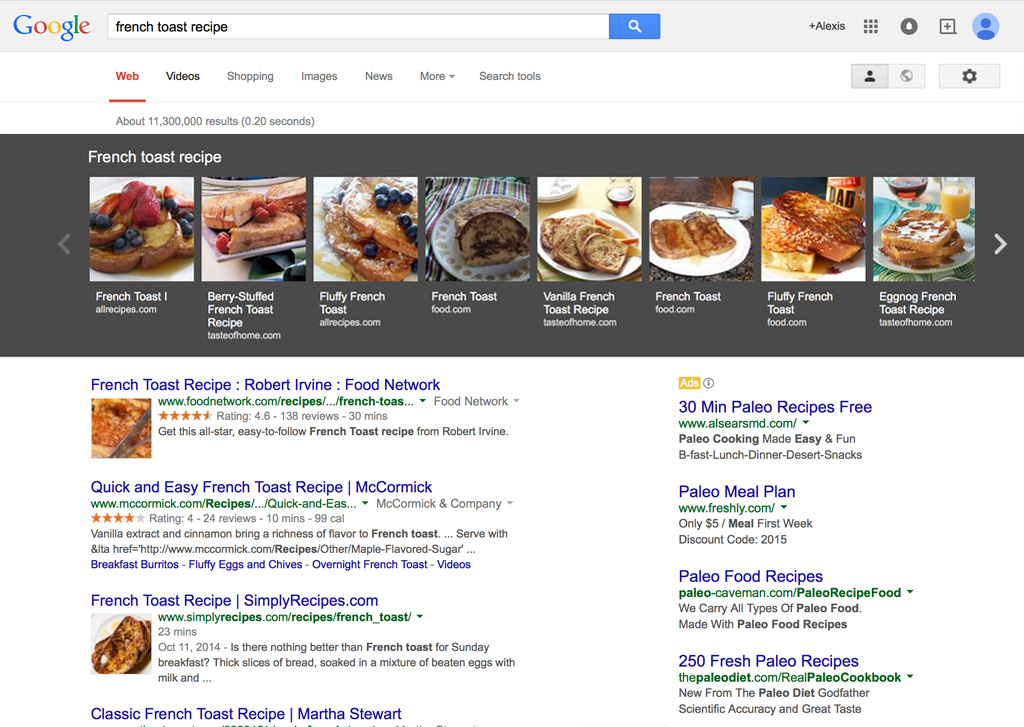
For this challenge I decided to transition the results page away from a directory format to a visual marketplace. Now Google Adwords can be optimized for better click through conversions and sponsored content is more visible. Not only will Google’s ad branch benefit but also other subsidiaries of Google like Google Shopping Express and Drive can be utilized, opening up a new revenue streams for the company.
Product Design
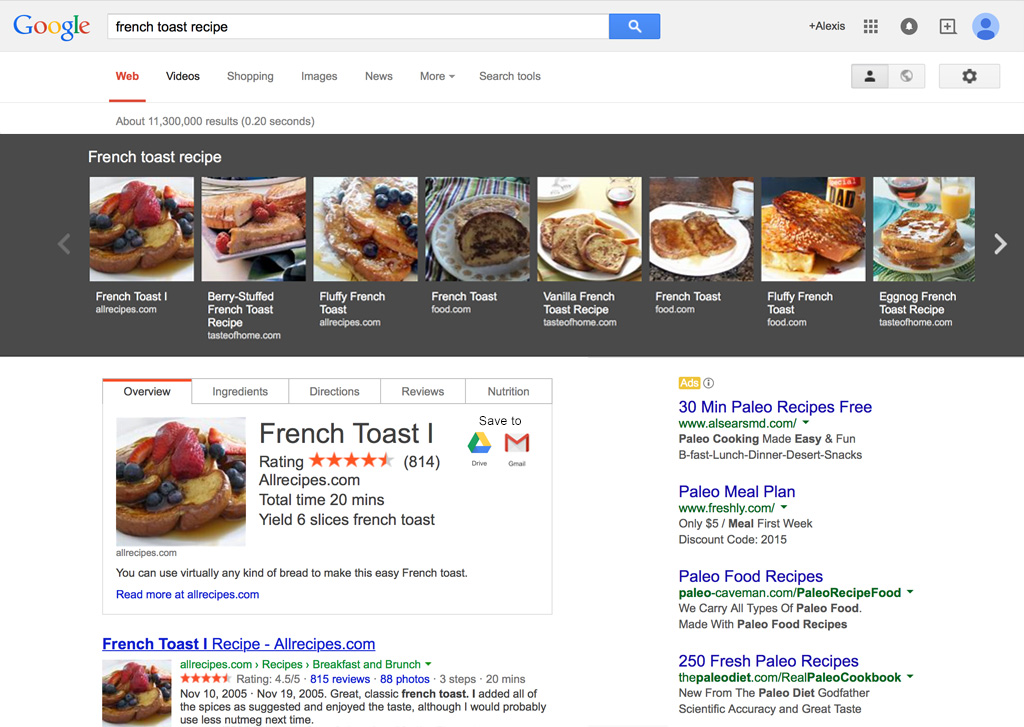
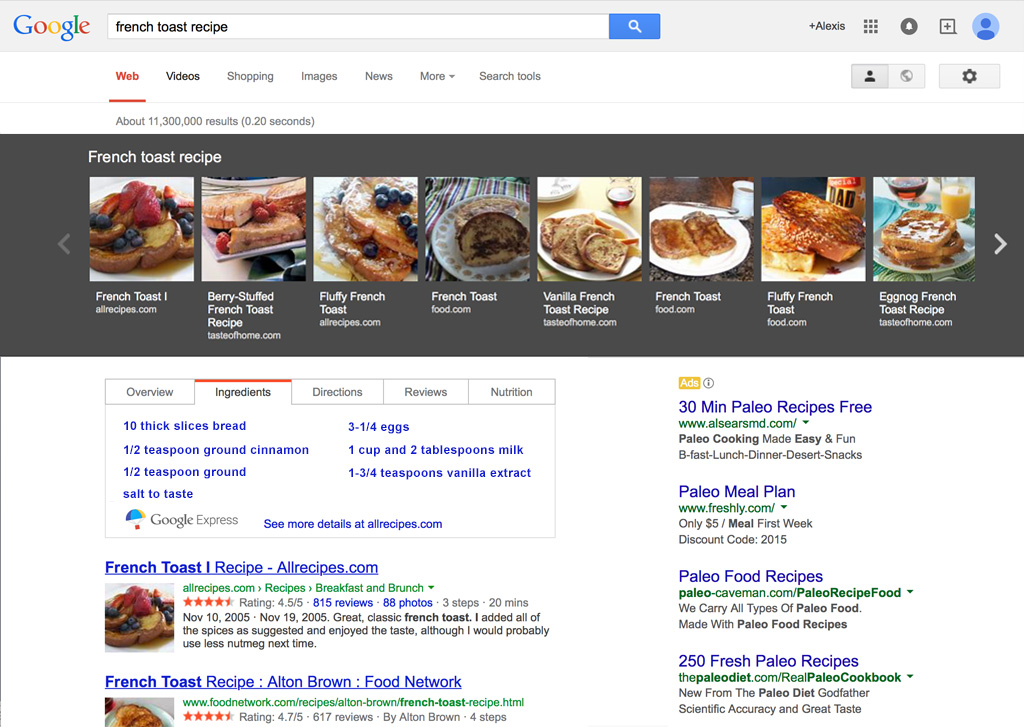
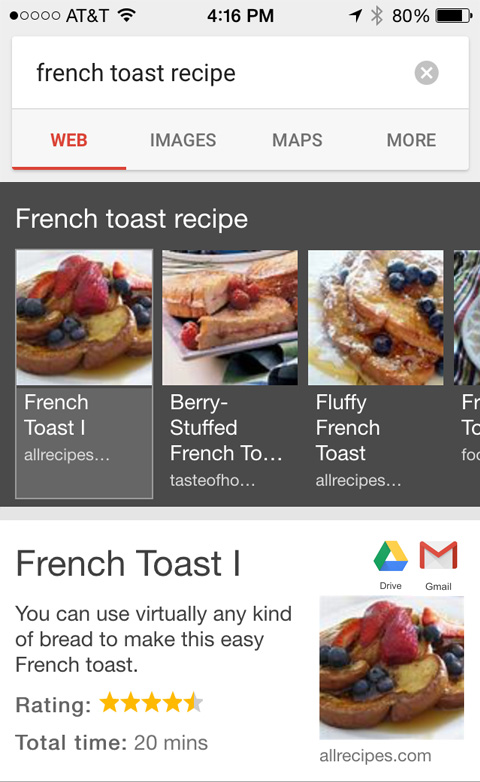
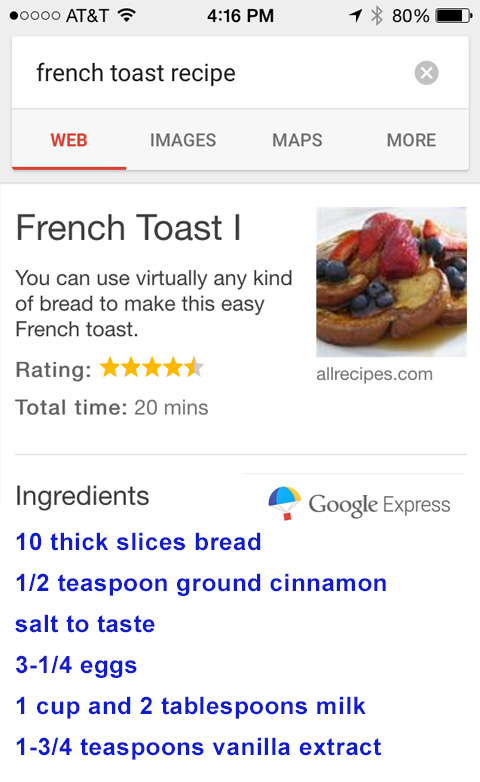
The inspiration behind this visual marketplace redesign came from Bing’s search result page. I really liked how Bing displayed recipe results visually and gave the user all the information s/he needs to find and complete a recipe on one page. The content displayed visually at the top of the page comes from Adwords and other sponsored content. When the user clicks on a recipe s/he can save the recipe to their Google Drive and share the recipe through Gmail. Additionally the ingredients listed for a recipe are hyperlinked to Google Shopping Express, so a user can save the recipe and have all the needed ingredients delivered directly to their home.
Feature Annotations
Desktop Design
Mobile Design

Product Strategy
The revenue strategy for this visual marketplace hits two areas: ad optimization and Google subsidiary integration.
Ad optimization is a key area to target because over 90% of Google’s revenue comes from advertising. Currently Google Adwords display ads either as the top search result or on the right column of a search page in text format. Adwords paid search ads have an average click-through rate of 2%. This visual marketplace strategy should raise the click-through rate average and Google can charge a premium fee for the sponsored content.
Additionally this strategy would integrate Google Shopping Express directly into the search page, creating a new revenue stream for search. Ingredients and cooking tools listed in the ingredients or direction sections will be hyperlinked to Shopping Express. YouTube and Google Drive can also be integrated into the visual marketplace. Utilizing YouTube on search opens up opportunities for native ads. For instance a Kraft or Hershey’s YouTube video can be displayed as a featured recipe within the visual marketplace view. Syncing Shopping Express, YouTube, and Drive into this feature will increase user engagement and open new revenue streams across all of Google’s products.
Conversely, a potential problem with this strategy would be page speed. Google is already sensitive to load time, which is why the site has resisted GUI add-ons to search. In the Technical section I will discuss testing strategies to ensure page speed isn’t compromised.
Market Analysis
The top three players in search are Google (65%), Yahoo (16%), and Bing (13%). The design of the visual marketplace feature is similar to Bing; however, the key difference is the integration of Google Shopping Express. Unlike Yahoo and Bing, Google can point directly to its own ecommerce platform to facilitate purchases and to share content. Again Google can fully integrate products such as Shopping Express, YouTube, Drive, and Gmail into its search feature and completely capture and keep users that would leave search after finding what s/he needs.
The target personas for this feature are young people learning to cook for themselves and moms looking for new and healthy recipes.
 Scott Fisher, Age 20
Student Learning to Cook
Scott is in his second year of college and adjusting to living in an apartment where he has access to a kitchen. Ramen and pasta have gotten boring and he’s looking for other easy to make meals. He never learned to cook while he lived at home with his parents and he finds himself Googling such things as how to boil water. Scott is also extremely busy as a business student and never finds the time to go to the grocery store.
- Income: Doesn’t have one, but living off an allowance from his parents who are upper middle class
- Demographic: Young white male, comes from stable home, single, lives in Los Angeles
Scott’s Goals:
- Make quick, easy meals
- Spend as little time as possible searching and finding recipes
- Cheap groceries that he can pick up quickly
 Madeline Right, Age 35
Mom Looking for Healthy, Quick Options
Madeline is a mother of two living in suburban Southern California. She works as an auditor and travels a lot for her job. When she’s home she takes on the majority of household responsibilities such as cleaning, planning her kid’s schedules, and making dinner and breakfast on the weekends. She works 60 hours a week and spends 10-20 hours doing housework. Her husband Steve is equally as busy and they have a nanny that takes care of their kids during the day. Madeline enjoys cooking but finds she has little during the week to make healthy meals. On Sunday mornings she looks online for healthy, quick dinner options and makes her grocery list. When she goes to the grocery store she likes to make her trips efficient.
- Income: Middle class
- Demographic: Asian woman, lives in a 4 bedroom house in a nice neighborhood close to Los Angeles
Madeline’s Goals:
- Healthy and quick meals
- Quick grocery trips
- Makes sure there’s food at the house when she’s traveling
Technical
To implement the visual marketplace feature there would be two fairly simple technical redesigns. Essentially search will be pulling in new feeds into search, including Shopping Express, YouTube, and Adwords. To implement the visual component, the front-end code would need to be altered to reflect the layout of the results page using a CSS3 template. To determine what content to display visually in the marketplace, the back-end Adword algorithm would need to be tweaked to prioritize sites with good images. Currently Adword is completely text based, to implement content into the marketplace the algorithm would need to link visuals with the text. The order and structure of Adword wouldn’t need to be altered because the redesign isn’t altering the logic of the program.
As mentioned in Product Strategy, there is a payoff between a primary text-based page and a GUI page. Google is sensitive to page speed and adding GUI elements to the page slows down load time. This strategy would only be effective if it increases click conversion rates and doesn’t compromise page speed. There are analytic tools I’m familiar with that measure these metrics. To test this strategy I’d use a combination of Optimizely and Google Analytics to measure click conversations and Google PageSpeed Tools to test load times. The decision to implement this strategy would incorporate these metrics.
Overall I believe this new feature is technically feasible and the potential results make this redesign a necessity.
 lexinteractive